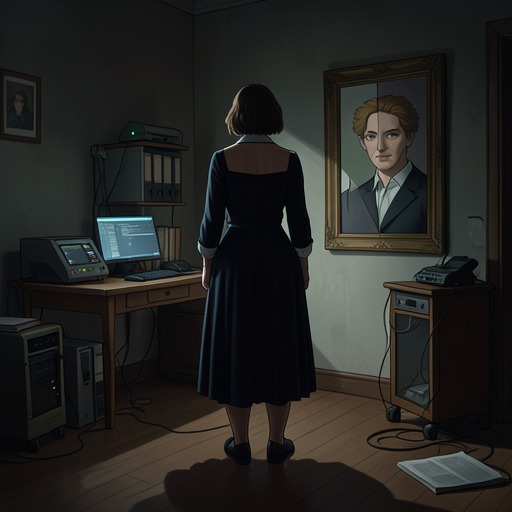
Bella's pregnancy and the death of her unborn child
Poor ThingsBella's pregnancy and the death of her unborn child are central to the revelation of the drowned woman's past and to the explanation of Bella's amnesia. The pregnancy is pieced together from an investigation and medical testimony: the woman was eight months and a fortnight pregnant when she disappeared, and Archibald McCandless later identifies the shock that destroyed her memory as the cause of the child's death. The narrative keeps the circumstances of her choices contested, setting her apparent rejection of life against the institutions and medical judgments that would have claimed authority over her body.
The pregnancy and the drowning
Three years after the woman's disappearance, detective Seymour Grimes reconstructs the case from police and Glasgow Humane Society records. A woman matching Lady Blessington's appearance had been seen diving from a bridge into the River Clyde on 8 February 1880 and was pulled from the water by George Geddes. Grimes reports that she was eight months and a fortnight pregnant. Her body went unclaimed and was taken for medical purposes; Godwin Baxter instead kept it alive at a cellular level and brought it to his father's laboratory.
The removal of her engagement rings prompts McCandless to suggest two possible histories: she may have been carrying the child of a husband she hated, or that of a lover she preferred who had abandoned her. This is an inference, not a settled account of the pregnancy. Baxter says he knew little of the life the woman had left behind, beyond his belief that she had chosen death rather than return to it. The evidence therefore presents the pregnancy alongside unresolved questions of marriage, abandonment, and the woman's own intentions.
The child's death and Bella's memory
When Baxter tries to tell Bella what preceded her arrival, his speech breaks down as he struggles to name the truth. McCandless supplies the missing fact: the shock that destroyed Bella's memory also killed the child she was carrying. Bella says she had feared this, then comforts Baxter as tears run down her face. Her response makes the disclosure intimate rather than merely clinical: the lost pregnancy is a grief she can recognize even though the past surrounding it is inaccessible to her.
Baxter's account of the body clarifies the sequence while also underlining its strangeness. He says he cleared the drowned woman's lungs of water and removed the foetus, but did not restore her to conscious life; instead, he maintained her body at a purely cellular level. Later, reports from specialists who examined Bella describe her amnesia as caused by injury to her skull and the loss of an unborn child. These accounts connect the bodily injury, the pregnancy's end, and the absence of memory, while leaving Bella without recollections from before she came to Baxter's house.
Medical authority and reproductive choice
The pregnancy is also entangled with the treatment proposed for Lady Blessington. Dr. Prickett says she suffered hysterical rages, wanted contact with her husband, and begged for a clitoridectomy; he claims that he postponed the operation until after the child was born. Baxter challenges the assumptions behind this diagnosis and treatment, and argues that the woman's conduct cannot be taken as proof of insanity. The testimony thus places the pregnancy within a medical dispute over who could define the woman's distress and decide what should be done to her body.
Bella's own later objection to medical inspection at the Paris workplace where Millie is involved extends the book's scrutiny of reproductive and sexual regulation. Bella argues that examining the women while leaving their clients unexamined is unfair and ineffective, and proposes that the clients be examined instead. Her position does not establish what the pregnant woman previously wanted, but it contrasts with a system that directs scrutiny and intervention toward women while treating male clients as beyond its reach.
Narrative significance
The pregnancy first appears as evidence in a detective's reconstruction, then returns as the crucial fact Baxter cannot bring himself to articulate and McCandless finally states. This delayed disclosure makes the child's death part of the story's larger question of how much of a person's identity can be recovered from a body and from other people's accounts. Bella's amnesia is not presented as an isolated mental condition: it is bound to physical injury and pregnancy loss, and its explanation arrives through a scene of shared grief.
The wider arguments over suicide, institutional confinement, and reproductive control sharpen that connection. Baxter fears that restoring the drowned woman to consciousness would force her into a society that treated suicide as lunacy or crime, and he points to poverty and social prejudice as reasons many young women drowned themselves. The pregnancy and the child's death therefore mark both a private bereavement and the limits of a medical system that claims authority over women's bodies while offering little room for their circumstances or choices.